A Level Art Coursework: AS Painting Project - abstract instruments
Concluding Updated on January 5, 2022
This As Painting Coursework project gained 100% in 2008. It was completed past Nikau Hindin, while studying A Level Art & Pattern (CIE 9704) at ACG Parnell Higher, Auckland, New Zealand.
Some of Nikau's sketchbook pages are included in our new book: Outstanding High School Sketchbooks . This book has high-resolution images so that fine details and annotation are clear, making it an excellent resources for students and schools. Learn more than!

Nikau began her As Coursework projection past conducting a visual investigation into instruments. She was peculiarly interested in traditional Maori instruments, and how these were used to tell stories that were passed from generation to generation. Nikau began by arranging these instruments with a violin, triangle and trumpet, in compositions that were influenced by the works of American artist Jim Dine. Vertically aligned, the instruments faded in and out of messy textural backgrounds, in the way that a memory or story might ebb and flow through generations – clear and distinct in some places; blurry and obscured in others. Oft these grounds were 'found' – i.e. bits of splattered pieces of newspaper that Nikau then worked over with washes of pigment and ink. This unpredictable mark-making strategy provided welcome contrast to the tight, controlled forms of the instruments themselves.
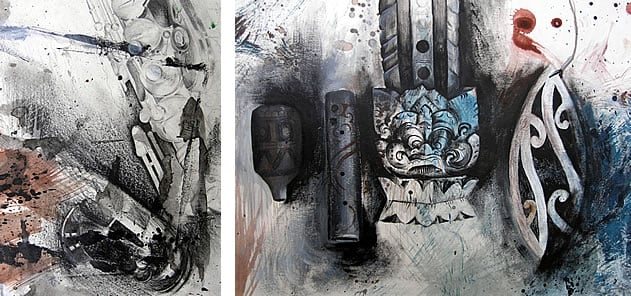
Throughout her folio, Nikau worked in a range of drawing and painting mediums, including graphite, Indian ink, black pen, coloured pencil, watercolour and acrylic pigment.
After completion of the first half of an A1 sheet of preparation piece of work, Nikau analysed her artworks (in an accompanying sketchbook which also contained artist studies and further media trials and exploratory work). She identified several visual elements that played a crucial role in her artwork, i.e. the repetition of stiff vertical lines (violin neck and strings / trumpet pipes etc); the repetition of curving, organic form (body of the violin and the kowhaiwhai patterns in the carvings on the Maori instruments). It was at this stage that a colour scheme was besides defined – i that would remain consistent throughout her Coursework project. These aspects of the limerick were considered carefully, not just in terms of their aesthetic potential, simply in terms of how they might allow her to best represent and express her ideas. For instance, the repetition of vertical lines – which became more than prevalent throughout her page – might help to express the passage of time, and the linking of mutual forms was a manner to illustrate the connection of ideas from by to present.

The adjacent stage of evolution resulted in the continued use of a wide range of media, splattered grounds, stenciled layers and the gradual disintegration and manipulation of tone and grade. The vertical cogitating lines on the trumpet were transposed onto to the surface of the violin and into parts of the background, while kowhaiwhai patterns from the carved instruments become a graphic element that interlaced beyond unlike parts of the painting. Many of the works were completed in series, with several pieces beingness worked on at one time. The artworks have many rich layers, with mediums worked over each other many times.

Over the remainder of the preparatory pages, Nikau continued to develop her work past abstracting form (with reference to cubist artists, such as Juan Gris) and playing with calibration. She refined and developed her painting technique, with translucent layers (created using gel medium and water) and irregular backgrounds contrasting abrupt, defined edges and tonal boundaries.
As Nikau was studying in New Zealand, she was non restricted by having to post her piece of work overseas for cess. As such, she was complimentary to trial painting on wooden boards. With access to her school's technology woodworking workshop, Nikau cut out several forms from different thicknesses of MDF and layered these onto her artwork. This made the surface of her work slightly sculptural and 3D.
The aspects of Nikau'southward Coursework Projection that were especially successful (aside from her obvious strength in observational cartoon and painting) are the personal nature of the folio, and the creative and confident handling of media.
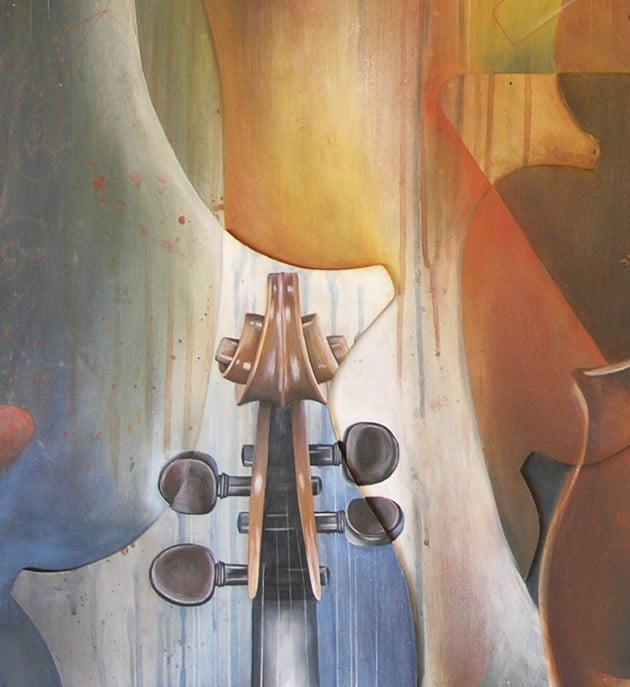
The final Coursework painting (shown beneath) was a big and impressive piece of work, approximately i.4m wide, on an MDF framed board.


The following video showcases Nikau's entire AS Painting Coursework projection, including her sketchbook, which contains media trials, written analysis and artist studies. (Note: for CIE, a sketchbook is not required at As Level, however it is common practise in New Zealand for students to consummate 1. As the examiners visit our schools to moderate student work, we are not bound past strict postage requirements).
Want to see more than inspirational student artwork? View our Featured Art Projects.

Amiria has been an Art & Design teacher and a Curriculum Co-ordinator for seven years, responsible for the course design and assessment of student work in two high-achieving Auckland schools. She has a Bachelor of Architectural Studies, Bachelor of Architecture (First Class Honours) and a Graduate Diploma of Teaching. Amiria is a CIE Accredited Art & Design Coursework Assessor.
Source: https://www.studentartguide.com/featured/a-level-art-design-coursework-as-painting
0 Response to "A Level Art Coursework: AS Painting Project - abstract instruments"
Post a Comment