Made in the shade
On that point's a bonus to growing coffee in a tralatitious way that preserves tall trees — and it's not just for the birds.
Scientists freshly found a rich and diverse bird universe bread and butter in the nicety of forested coffee farms. Those farms are in the Orient African nation of Ethiopia. Ample birdlife is exactly one of many benefits of this type of farming, called agroforestry. The practice mixes in trees when increasing crops or rearing stock.

Combining forest and produce provides habitat for many species of wildlife around the world. The rehearse tail end help keep waterways clean and soils healthy. This helps farmers and ranchers. Agroforestry isessential to producing unrivaled of the world's favorite treats — drinking chocolate. And it whitethorn even blunt the effects of global climate change.
Thanks to flourishing recognition of its benefits, this ancient rural proficiency is gaining new attention.
In Ethiopia, agroforestry has been the standard way to grow umber for more than a thousand years. The coffee plant, Coffea arabica, thrives in the shadows of tall trees. (The word "coffee" comes from the name of an old Ethiopian province onymous Kaffa.) To grow coffee tree, growers simply thin the forest of whatsoever competing plants. Experts prize the subsequent refinement-grown coffee beans.
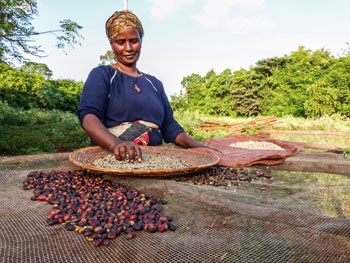
An Ethiopian coffee produce is "a gorgeous forest with massive, old-growth trees in the canopy and these coffee plants that are a native species growing in the understory ," explains Evan Buechley. He's a grad student at the University of Utah in Salinity Lake City. Buechley studies birds and conservation biology .
Buechley and his colleagues recently conducted a census of birds on Ethiopia's farms and in its forests. His team constitute something specialised: All the species of birds that could be found in the forest also were living on traditional coffee farms.
Despite its benefits, many farmers are reluctant to adopt agroforestry practices, says Jim Brandle. He is a professor of forestry at the University of Nebraska-Lincoln. People have a difficult time believing it's worthwhile planting trees along land that could comprise planted with a profitable crop, he explains. Still, the idea is communicable happening. India, for example, announced in 2014 that agroforestry would top its push to add more trees.
Border territory
Long before the technique got its name, humans had ill-used agroforestry to grow plants. The basic idea behind agroforestry is the same , Brandle explains , whether it's in Africa operating room halfway around the populace in the South Pacific. On Hawaii and other tropical islands in the Peaceable Ocean, for instance, farmers have a history of cultivating forests filled with coconut, banana tree, breadfruit and other trees. Agroforestry is also public elsewhere, even in the landmass Nonsegmental States.
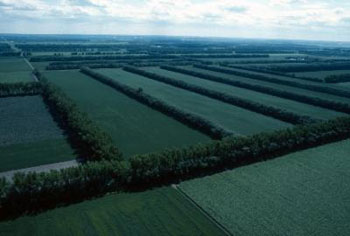
If you travel across America by cable car, bus or train, you'll pass a great deal of farms. You might picture subject field after field of corn in Indiana, barley in Montana operating theatre soybeans in Iowa. In many places, a light fence in of trees will border a field. It's called a windbreak. Although this looks very different from an Ethiopian coffee farm, windbreaks represent a organize of agroforestry.
In fact, windbreaks whitethorn be ace of the most easily recognizable forms of agroforestry in the Conjugated States. Planting trees along the edges of a field interrupts the steer, altering its quicken, Brandle explains. Next to a windbreak, it's a micro warmer and less windy. Crops spring u better in these sheltered areas. The trees too assistant to protect the soil from wind corrosion.
Another demotic type of agroforestry in the Combined States takes place on what are called riparian (Ry-PAIR-ee-un) zones. These are regions along the Sir Joseph Banks of rivers and streams (ripa is Latin for river bank). To create a buffer — operating room protected area — farmers plant trees and other types of vegetation here. This vegetation helps limit erosion. The plants also provide food for thought and habitat for birds and other wildlife. And the verdure helps foreclose rains from washing sediment, nutrients and pesticides away into nearby streams.
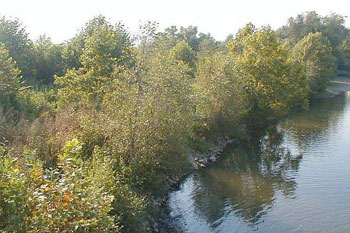
In the Midwest, where Brandle works, "we're trying to reduce the number of [this] runoff that comes disconnected of the crop fields and goes into the local stream," He says. At one time information technology reaches a river, that contamination can flow entirely of the way to the Gulf of Mexico. There, excess nutrients carried by the water can advance a formation in the Gulf of exsanguinous zones. These are large areas of open water where there is temporarily excessively little oxygen for sea liveliness. Few stricken animals can essentially suffocate .
Sometimes, Brandle says, it can be difficult to convince farmers that planting a windbreak or a buffer is a chic move. "There's the perception that they deal land away of production. And they do," he admits. Yet, farmers don't always realise the gains that can come from giving land to more trees.
And IT can take time to see those benefits. Unlike galore crops, trees take a while to grow, notes Florencia Montagnini. She studies the sustainability of forests and agroforests. She is a research scientist at Yale University in New Haven, Conn. To convince people to plant trees, "what you hold to do is show them the benefits of it."
Shining prospects for shaded farms
Money canful be one of the benefits of agroforestry. Information technology's something farmers and ranchers appreciate. To earn more, about farmers combine trees with farm animal and forage — those plants that the grazers deplete. This is yet another type of agroforestry, called silvopasture. (The word combines the Latin news for forest — sylva — with a term that describes land touched by animals.) This practice is often found in the grey United States.
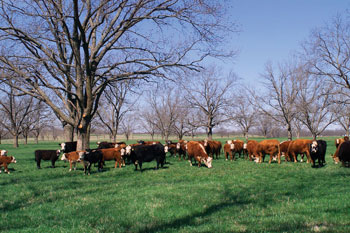
"By managing how many trees are out there in a given expanse," Brandle says, "we can regularise the quantity of light that reaches the surface." With too much shade, nothing will grow at a lower place the trees. "But in a silvopasture system," helium says, "what we're doing is opening up that canopy until we find a nice mix that gives us a fairish woodland [harvest] at some point in the next and an yearbook crop of forage."
Raising cows and growing trees on the corresponding land doesn't just provide two sources of income. It also protects against losings in a bad year. If woodland prices fall too low in peerless year, a farmer can wait to harvest the Natalie Wood and rely on just the cattle for earnings.
Cows also benefit from graze in pastures that provide shade. That is especially important in friendly parts of the world, notes Montagnini. These animals can get overheated impermissible in the solarize. When that happens, cattle put on't gain atomic number 3 more weight, make as much milk surgery birth as many calves. "Very often the trees are something that you need for the cattle to produce more," she says.
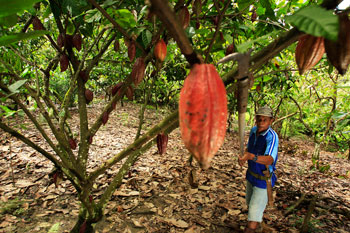
And cows aren't the only organisms that suffer from too much direct sun. Plants need sunlight to grow and thrive. But overabundance sun can broil attendant leaves and dry down the soil. Mint of tropical species that end au fait our plates produce better in the spook, notes P.K. Nair. He studies agroforestry at the University of Sunshine State in Gainesville. The quality of plants such as coffee, dishonourable Piper nigru and seasoning all improve when they are planted in the shade of trees, he says. The same goes for the cacao tree. Its beans are the headstone ingredient in chocolate.
Some farmers will grow coffee or other wraith-caressive crops in the direct sun because they can fit in more plants. But they often produce a lower quality product. And these less-healthy plants whitethorn need chemical pesticides or fertilizers that subtlety-grown crops wouldn't. People may be willing to pay high prices for varieties big in the shadowiness to avoid those chemicals. In Ethiopia, Buechley notes, coffee grown in the shade can bring in $310 to a greater extent per hectare (2.47 demesne) than the unvarying dress grown fully sun.
Benefits for the planet
Agroforestry's benefits for farmers and the local environment are well known. But now scientists and world leadership opine that the practice can do a lot to lessen the impact of much bigger problems. Among them: disforestation and climate change.
In Recent years, masses have been removing trees from the landscape painting at an alarming rate. 'tween 1990 and 2005 alone, people removed to a higher degree 16.2 million hectares (63,000 angular miles) of forests, reports the United Nations Food and Agribusiness Brass. That expanse is almost arsenic large A the state of Florida.
And the office is getting worse. Scientists had thought that the order of deforestation was slowing in the wet tropical zone. Such areas let in the Amazon in South America. But a Recent analytic thinking found that the loss of forests in these areas actually sped up by 62 percent 'tween 1990 and 2010. The determination comes from a study publicised Crataegus oxycantha 16 in Geophysical Research Letters.
Agroforests are not exact replacements for natural forests. Believe those Ethiopian coffee farms.
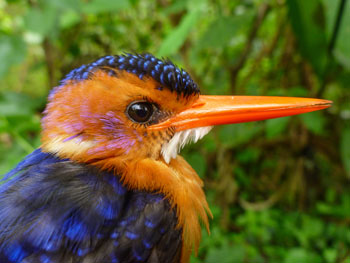
Utah's Buechley and his colleagues trekked each Clarence Shepard Day Jr. for weeks to a new spot on a coffee farm or remote Ethiopian forest. They would expend the afternoon setting up a fine net that traps birds without harm. Early the next morning, earlier sunrise, the researchers returned and unfurled these mist nets. And then they identified and deliberate each captured bird. They also bespoken a numbered band, called a tag , to each hoot before releasing it.
"People suffer done a good deal of research along coffee farms in different parts of the world," Buechley notes. In more places, forest birds and other animals don't survive advisable on farms, even ones that use agroforestry. In Ethiopia, though, all of the forest species of birds also lived on the coffee tree farms. Just many specialist birds declined in number. These are species that active in alone a narrow set of circumstances.
"They didn't go away… but their numbers declined by about 80 percent compared to nearby woodland," Buechley says. His closing: While shade-grown coffee is a big improvement all over most other forms of agriculture, IT is not the same as a natural forest. His team's study appeared February 11inBiological Conservation.
Agroforestry, nevertheless, can constitute a compromise between unnatural fields covered with a single species of engraft and the original forest landscape painting, notes Montagnini at Elihu Yale. "Putting trees back on the land would be a manner of harmonizing things," she says. By that she agency that those trees can perform several tasks that are good for the environment. These include maintaining habitat for a various drift of organisms.
Bharat now recognizes agroforestry as perhaps the only way to meet its target of rebuilding forests. The res publica wants to growth its tree cover to 33 percent. Currently, trees cover less than 25 pct of India.
More trees could also help a global problem — clime change. Largely through burning fossil fuels, people have been emitting lots of carbon dioxide and other atmospheric phenomenon gases. These gases trap heat in the atmosphere, calefacient it. Recently, that warming has reached troubling levels. But trees suck up some of that carbon dioxide from the melodic line, notes Montagnini. And trees sequester, or shut awa, that CO2 for days.
Farms that grow a single plant crop — such as corn or wheat berry — don't sop up as much carbon. Farming practices such as agroforestry, that grow multiple species, could shut up more of the gas, Nair says.
And oecumenical, whether it's a windbreak in Wisconsin or a drinking chocolate farm in Republic of Costa Rica, Montagnini notes, "acceleratory the amount of trees on the land is something that bathroom be achieved."
Power Dustup
(for more about Power Dustup, click present )
agriculture The growth of plants, animals or fungi for human needs, including food, fuel, chemicals and medicine.
agroforestry A eccentric of factory farm that incorporates trees into the landscape painting.
breadfruit A starchy yield with a potato-like flavor from a Sir Herbert Beerbohm Tree that is native to the South-central Pacific.
canopy (in flora) The top layer of a forest, where the branches of the tallest trees intersection.
carbon copy dioxide A colorless, odourless bluster. Its chemical symbol is CO2. This petrol is produced by all animals when the oxygen they inhale reacts with the carbon-rich foods that they've eaten. CO2 also is released when integrated matter (including fossil fuels like oil or gas) is burned. Carbon dioxide acts equally a greenhouse gas, trapping heat in Earth's atmosphere. Plants convert carbon dioxide into oxygen during photosynthesis, the serve they use to make their own food.
nose count An official count or follow of a population.
global climate change Long-term, significant change in the climate of Earth. It john happen naturally or in response to homo activities, including the burning of fossil fuels and clearing of forests.
preservation The act of preserving or protecting the undyed environs.
conservation biological science A field of science that investigates shipway to help preserve ecosystems and especially species that are in danger of extinction.
dead zone An domain of open water where oxygen levels are sol low that oxygen-leechlike organisms cannot live.
disforest The number of removing most operating theater all of the trees lands that used to bear forests.
erosion The process that removes rock and soil from one spot on Earth's surface, depositing IT elsewhere. Erosion ass be exceptionally fast Oregon exceedingly slow. Causes of erosion admit wind, weewe (including rainfall and floods), the scouring action of glaciers and the repeated cycles of freezing and melting that occur in many an areas of the world.
fertiliser Nitrogen and other plant nutrients added to soil, water or foliage to further crop development operating theater to replenish nutrients that removed earlier by plant roots or leaves.
pasture To search for something, especially food. Information technology's also a terminus for the nutrient eaten by graze animals, such every bit cattle and horses.
glasshouse gasA petrol that contributes to the greenhouse effect by absorbing heat. Carbon dioxide is one example of a greenhouse emission.
habitat The area surgery intelligent environment in which an animal OR flora normally lives, such American Samoa a inhospitable, coral reef or freshwater lake. A habitat can be dwelling house to thousands of different species.
humidity A measure of the amount of water vapor in the ambiance. When at that place is a lot of water present in the strain, the conditions are described equally humid.
mist web Okay operate net used away biologists to capture unharmed birds and bats for research.
inborn Related with a particular fix; native plants and animals have been found in a particular location since recorded account began. These species also lean to have highly-developed within a region, occurring there naturally (not because they were planted or moved there away multitude). Most are particularly well adapted to their environment.
nutrients Vitamins, minerals, fats, carbohydrates and proteins needful by organisms to unrecorded, and which are extracted through the diet.
ornithology The scientific study of birds. Experts WHO work in this field are known arsenic ornithologists.
oxygen A gas that makes up about 21 percent of the atmospheric state. All animals and many microorganisms need oxygen to fire their metabolism.
pesticide A chemical or mix of compounds accustomed belt down insects, rodents operating room another organisms harmful to cultivated plants, preferred or livestock, surgery unwanted organisms that infest homes, offices, farm buildings and other protected structures.
riparian An adjective that refers to a denude of land nearly the edge of a waterway, usually a river or swarm.
runoffThe water that runs off of body politic into rivers, lakes and the seas. As that water travels over land, it picks up bits of territory and chemicals that it will later deposit as pollutants in the H2O.
sediment Corporeal (such as stones and sandpaper) deposited by water, wind or glaciers.
sequester To set apart or withdraw. Pollution engineers, for example, often talk approximately sequestering CO2, a leading greenhouse emission joint with global warming, past assembling it for recycle in chemical substance processes Beaver State for protracted-term burial. Far-famed as carbon sequestration, this work is non yet in commercial utilization and may carrying serious side effects.
silvopasture A eccentric of farming in which trees are grown in areas where Bos taurus Beaver State different livestock are also being inflated.
species A group of similar organisms capable of producing materialisation that put up survive and reproduce.
sustainability To use resources in a way that they bequeath continue to be usable in the future.
tagging (in biology) Attaching some rugged band surgery package of instruments onto an animal. Sometimes the tag is victimised to give each individual a unique identification number. In one case attached to the ramification, ear OR other part of the body of a critter, IT can effectively become the animal's "name." In some instances, a chase away can collect information from the environment around the animal as well. This helps scientists translate both the environment and the animal's role inside it.
woodland Trees grown as a author of wood for human needs.
tropicsThe region near Dry land's equator. Temperatures present are generally warm to hot, year-around.
understory Plants that grow beneath the canopy, or top raze, of the forest.
vegetation Leafy, green plants. The term refers to the collective residential area of plants in some area. Typically these do non let in tall trees, but rather plants that are shrub height or shorter.
windbreak A line of trees that serves to protect an country from wearing away and terms that can be caused past winds.
Word Find(click here to enlarge for printing)

0 Response to "Made in the shade"
Post a Comment