What Age Do Gifted Kids Learn to Read
Children who read before starting kindergarten tend to impress most people. You see a five-year old reading The Hobbit and you lot call up, "Dang! That kid is S.Yard.A.R.T."
Gifted, they nigh certainly are; but, early reading does non e'er guarantee phenomenal achievement in loftier school. Final week I blogged most early readers who don't always reach the bookish potential that parents and teachers expected back in beginning form.
For some kids the expectations were merely a wee flake too loftier. For others, an underlying learning disability hadn't been diagnosed, all the same. And then there'southward the group of gifted kids who intuitively learned the fundamentals but still needed directly educational activity in some part of the reading process earlier they could go along to move ahead with their learning.
When you read research on the topic of early reading, it's easy to exist swayed by the notion that precocious reading is a requisite skill for later high achievement. Consider some findings reported over the last ninety years:
- 43% of Lewis Terman's Genetic Study of Genius adults (that began in the 1920s) were reading earlier age 5.
- 80% of 13- and 14-yr olds who scored a 580+ on the SAT Verbal department were reading by age 5, as reported by Joyce VanTassel-Baska from College of William and Mary.
- 90% of profoundly gifted students (including Terence Tao) followed past Miraca Gross' longitudinal study in Australia were reading earlier age v.
So, what almost gifted children who were not early readers? Are they not every bit smart every bit their precocious reading friends? Is academic success not in their future?
In an interview with Northwestern University'south Center for Talent Development, Dr. Nancy Robinson, a noted scholar and founder of the University of Washington's Early Entrance Program for greatly gifted children, frames it this way. "Early reading is conspicuously a sign of existence at least "medium brilliant," she says, earlier going on to note that it is not a skill exhibited by all gifted children.
Some highly and profoundly gifted children are capable of becoming early on readers but choose not to develop the skill. The reason may be every bit unproblematic as non wanting to surrender the special snuggly reading time they've come to enjoy with their parents – withal, that very same kid goes on to graduate high schoolhouse at age 14.
Visual-spatial children – those who seem to learn things in whole chunks rather in a more linear, stride-by-step fashion, take also been noted as tardily-readers. Visual-spatial children, as a grouping, tend to memorize whole words, rather than learn phonics skills.
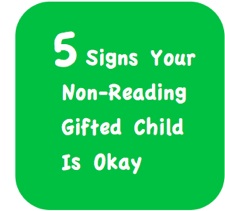
A number of other reasons tin can account for why an otherwise bright child may not exist reading before the historic period of 5. The following checklist may help parents tease autonomously if non-early reading is part of their child's normal developmental path.
- Playing With Sounds and Words
Does your child like to make rhymes or play alliteration games, where they use the aforementioned first sound for every word in a sentence? Playing with oral language like this demonstrates an inherent understanding of essential phonological skills and provides critical practice that leads to eventual reading success. Children who accept had a large number of early on ear infections have been found to be delayed in acquiring phonological awareness skills. This does non mean the child won't become a successful reader, but they will need some extra help in gaining skills they missed when they were ill. - Reading Environmental Print
Environmental print includes corporate and sports logos, street signs, and other visual images that contain print and communicates information. Children may "read" environmental print when they see a fast food sign and tell you they're hungry for a hamburger. Such reading and responding shows u.s.a. that the kid understands that symbols, letters, and words communicate ideas, which allows people to collaborate with the world and each other. - Rich Vocabulary
Decades of research tell us that children with a large vocabulary in their younger years tend to accept college reading achievement in middle and high school. You don't accept to count every different word your kid speaks to know if they're at that 20,000 discussion "rich" level. Instead, throw in the occasional large word in your own chat. Or, read vocabulary rich picture books together. Meet how your child responds to unfamiliar words. Can they deduce meaning? Do they connect the new word to words or ideas they already know? Do they begin to use the word in their ain vocabulary? Seeing a kid use these skills lets us know they're thinking like a reader. - Circuitous Sentences
Reading a paragraph is very different from reading a pack of flash carte du jour words. In order to understand the paragraph, a reader must be able to sound out every word – and then remember what each word ways within each judgement – and how the pregnant of each judgement links together within the paragraph. That takes a lot of brain power for a half dozen-year old. Young children who apply and understand complex spoken linguistic communication testify u.s.a. that they accept the cognitive ability to call up and admission the language skills that will eventually exist used when they learn to read. Then, what is a complex sentence? It's the ability to correctly execute a 3-step command at the age of iv, such as "Go upstairs. Become your shoes. And ask Dad to put them on for you." Or, it'south the ability to listen to a story and retell the beginning, middle, and end with footling or no prompting. - Healthy Vision
Children who appear impuissant and knock into furniture equally they walk through a room or get disoriented when surrounded by lots of visual patterns (think a decorated carpet pattern) may have a visual impairment, such as lazy heart, cross-eye, convergence insufficiency, or fifty-fifty nystagmus (a condition that causes the optics to exist in abiding motility). Visual impairments do not crusade dyslexia but they can make learning to read a hard task. Handling may be something equally simple every bit an eye patch or as complex every bit surgery. Rarely is vision therapy the right treatment option.
For many gifted children, non-early reading is not the aforementioned equally belatedly reading. Learning to read at the typical age of 5 and 6 does non necessarily mean the gifted kid will fail to thrive in schoolhouse or that a learning disability exists. It may only be that kid'south "normal".
Parents with nagging concerns nearly reading ability should talk with their pediatrician or a reading specialist for aid in gauging when to pursue testing to run into if an underlying problem is holding their kid back.
Was your kid a late reader? Did you observe a problem subsequently on or was it developmentally normal for your kiddo?
- Vision Problems That Can Affect Learning
six types of visual impairments – their prevalence in pupil populations – and how the vision problems effects learning. - Reading Rockets
Your get-to site for helping children acquire to read.
Source: https://everyday-learning.org/non-early-reading-gifted-child/
0 Response to "What Age Do Gifted Kids Learn to Read"
Post a Comment